our motto
The Barkly House motto is ex fine origo: in my end is my beginning. At Barkly House we approach education with a view to the future of our children. Aspects of this approach are discussed below.
The Barkly House motto is ex fine origo: in my end is my beginning. At Barkly House we approach education with a view to the future of our children. Aspects of this approach are discussed below.
At Barkly House we want our children to be lifelong learners and therefore we teach through play as this is the best way for them to learn. Play is the work of children. It is a non-threatening and happy experience which enhances their self image.
There are many different types and levels of play. Children need to experience all of them. We create opportunities in our school to facilitate all the types and levels. Play assists children’s needs in all areas of their development.
Play does not mean that the children can just do as they want. The teachers present all areas in the school to optimise play and learning.
Benefits of Play
What Does Play Mean for Children?
Developmental Stages of Play
Play
You say you love your children
And you are concerned they learn today.
So am I – that’s why I’m providing
A variety of kinds of play.
You’re asking me the value
Of blocks and other such play.
Your children are solving problems –
They will use that skill everyday.
You’re asking what’s the value
Of having children play?
Your daughter’s creating a tower –
She may be a builder someday.
You’re saying you don’t want your son
To play in that “sissy” way.
He’s learning to cuddle a doll –
He may be a father one day.
You’re questioning the interest centres;
They just look like useless play.
Your children are making choices –
They’ll be on their own some day.
You’re worried your children aren’t learning
And later they’ll have to pay.
They’re learning the pattern for learning –
For they’ll be learners always.
by Leila P. Flagg from The Very Young
Barkly House Kenilworth Pre-Primary School offers a 3-year programme for children from the year that they turn 4 until the year they turn 6. Our mission statement is: “Every child is developed holistically through play to the best of their ability in a structured environment.” This mission statement informs all our interactions, preparations and planning for each individual child every day.
Our philosophy of education is an eclectic approach based on the theories of Piaget and Montessori (Cognitive Theorists), Bruner (Discovery Theorist focusing on the importance of the environment) and Vygotsky (Developmental Psychologist focusing on the importance of a teacher and on interaction for learning and language development).
The school uses the integrated open-plan method. This is based on systems used in England, America and Wales. The general characteristics of this method are:
Early Literacy
Throughout our preschool programme we are in fact teaching both literacy and numeracy. All the underlying skills required for learning to read and do mathematics are included in every activity and area every day. We focus on listening skills during teacher-directed activities and teach the children to focus their listening. This is done through the use of informal age-appropriate activities.
Listening skills form the basis of all formal learning as well as, very importantly, phonological awareness without which one cannot spell, read or write. We teach children to rhyme and create their own rhymes as well as listening for and identifying specific sounds in words. Once they are able to do this we then introduce them to the sounds of the alphabet. This gives them a rich phonological background on which they can base their formal reading and spelling skills. We nurture and facilitate reading but do not formally teach it. If a child asks for a word we will write it down. We also expose them to words on charts that they are encouraged to use. By writing captions of what they want to say about their artwork, we provide a link for them between their thoughts and the written word. Our environment is structured in a way that children are immersed in a rich environment of language and the necessary sub-skills for learning to read.
These are some of the skills necessary for a child to reach their full potential as a reader:
Early Numeracy
Children require a great deal of hands-on activity to be able to understand basic mathematical concepts. They experience these concepts when playing in the garden, interacting with the various tables and participating in activities inside the school. This physical activity gives them the foundation on which to build abstract mathematical concepts.
Counting and Number Work
It is vitally important that children have a great deal of exposure to actively manipulating objects for counting activities and games before they are taught number operations (sums). All children can learn the recitation 1+1=2 but they do not necessarily understand it. We focus on doing a great deal of activities involving objects so that the children can internalise their concept of numbers. In this way they gain a firm foundation on which all their mathematical knowledge can be built in formal education. Once they are able to play with and manipulate objects according to our criteria we teach them how to halve and double numbers as well as to do more and less. We encourage them to use many different problem solving skills.
We expose them to as many activities involving numeracy and teach them to love numbers and problem solving and to have confidence in their abilities by always making sure that the activity is within their understanding. We do not formally teach them bonds but we nurture their numeracy skills so that they can enjoy manipulating numbers.
We teach literacy and numeracy with this quote in mind: “Let me not teach these children too fast for they are living in their present world, not in an adult’s present world or a child’s future world” (Dr M.J. Grey)
Three to Four Years Old (Younger Group)
Posture and Large Movements
Vision and Fine Movements
Speech
Social Behaviour and Play
Four to Five Years Old (Middle Group)
Posture and Large Movements
Vision and Fine Movements
Hearing and Speech
Social Behaviour and Play
Five to Six Years Old (Older Group / Grade R)
Posture and Large Movements
Vision and Fine Movements
Hearing and Speech
Social Behaviour and Play
We use an integrated approach based on themes which we change every two weeks. The themes are related to the child’s immediate environment.
Interest Tables (where the children can manipulate the items on display):
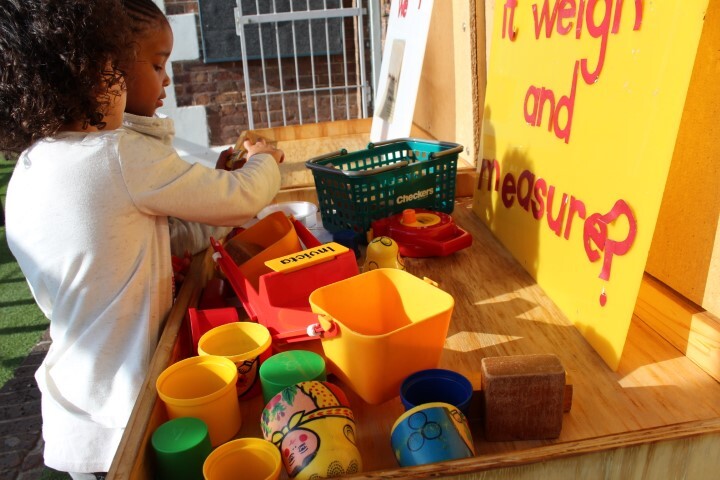
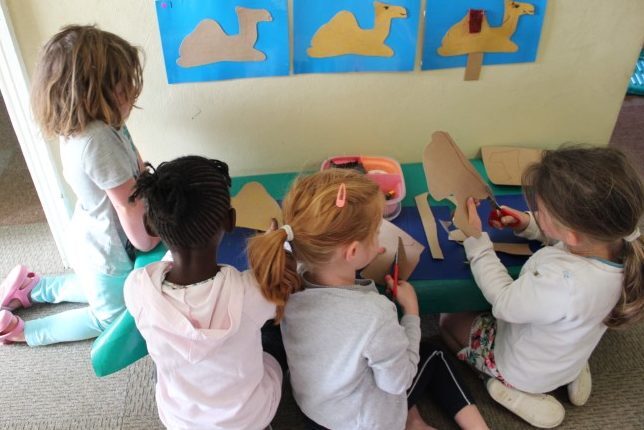
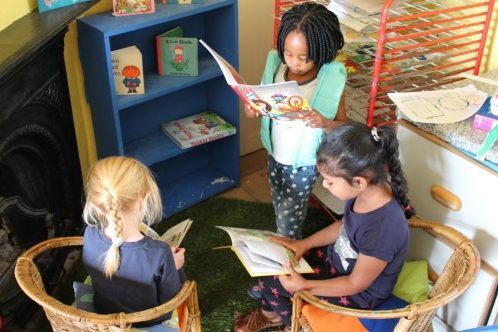
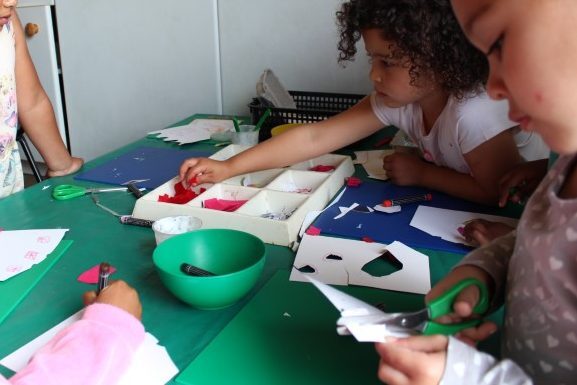
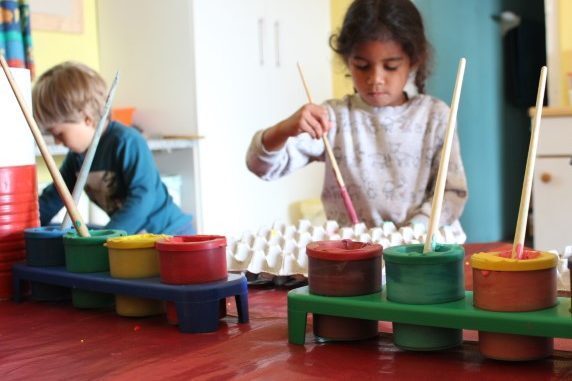
We encourage the development of each child’s creativity and all these activities are differentiated so that children can enhance their artwork according to their level of development. All the activities discussed below are available every day.
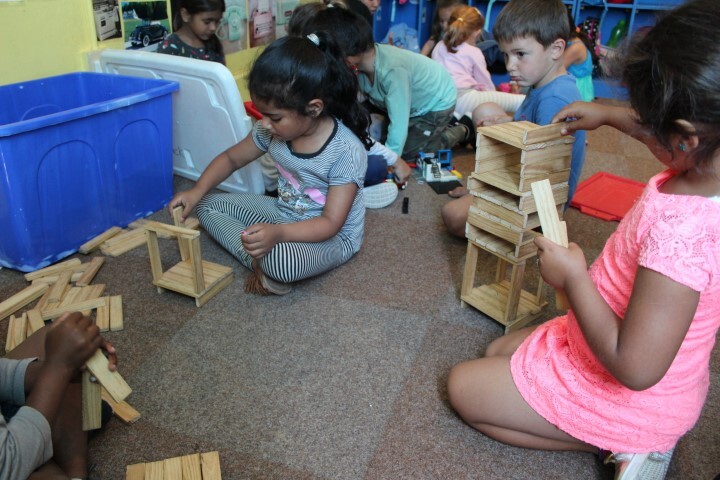
Gross motor and pre-numeracy skills are developed in these areas through play and discovery: